The Solar Tax Credit May Still Be Available. Just Not the Way Most Homeowners Think
Most homeowners think the solar tax credit conversation is over.
For a standard personal residence, that may be true.
But your property may not be standard.
If you own a rental property, operate a real business from home, own an Airbnb, or use part of your property for business activity, there may still be a commercial solar tax credit path worth reviewing with your CPA.
That is the part most homeowners miss.
The better question is not simply:
“Can I Still Get a Solar Tax Credit?”
The better question is:
“Can My Utility Bill Be Turned Into Long Term Solar ROI?”
Because your electric bill has no payback:
- You pay it every month.
- The money leaves.
- There is no breakeven date.
- There is no ownership.
- There is no long term return.
Solar changes the math.
A properly designed solar system can turn a monthly utility expense into a long term energy asset that produces power, offsets future utility spending, and gives you a measurable payback timeline.
And if your property has rental use or real business use, your CPA may be able to review whether commercial solar tax credits and depreciation improve the return even further.
The first step is not guessing.
The first step is getting a custom solar proposal.
Your Electric Bill Has No ROI. Solar Might
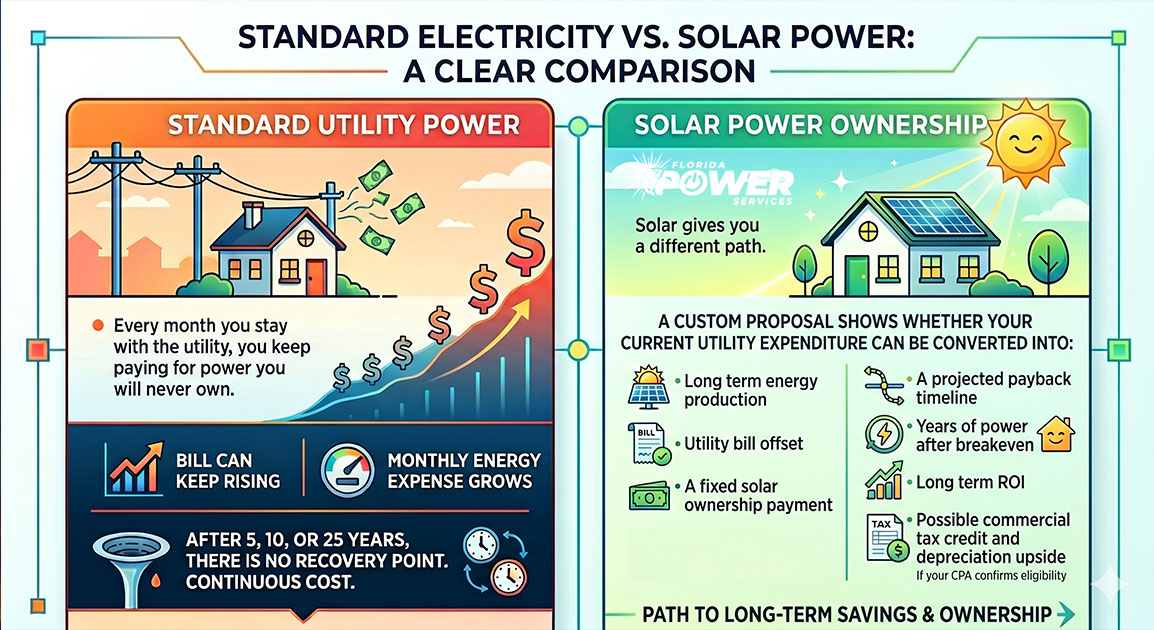
Every month you stay with the utility, you keep paying for power you will never own.
That bill can keep rising.
Your monthly energy expense can keep growing.
And after 5, 10, or 25 years, there is no recovery point.
Solar gives you a different path. A custom proposal shows whether your current utility expenditure can be converted into:
• Long term energy production
• Utility bill offset
• A fixed solar ownership payment
• A projected payback timeline
• Years of power after breakeven
• Long term ROI
• Possible commercial tax credit and depreciation upside if your CPA confirms eligibility
That is the reason to get the proposal.
Not because every homeowner qualifies for a commercial tax credit.
Not because solar should depend on tax incentives.
Because you need to see the numbers.
The First Test: Does the Solar Payment Beat the Utility Bill?
Before tax credits, before depreciation, before any advanced tax discussion, the first test is simple:
Can Your Fixed Solar Ownership Payment Be Lower Than Your Current Electric Bill?
If the answer is yes, the project may already make financial sense before incentives.
Your utility bill is a moving target.
Your Fixed Solar Ownership Payment is not.
With solar ownership, you are not just paying another monthly bill. You are replacing a variable utility expense with a fixed ownership payment attached to a system that produces energy for your property.
That fixed payment matters because utility rates do not stand still.Based on recent local utility rate history, rates have averaged an 8.7% annual increase over the last 5 years.If rates continue rising, the value of the power your solar system produces can become stronger over time.
That is where ROI starts to build.
What a Real Solar Proposal Should Show You
A serious solar proposal should not be a one page guess.
It should show you the energy math.
Your Florida Power Services proposal can show:
• Your current utility usage
• Your recommended system size
• Your estimated annual solar production
• Your projected utility offset
• Your Fixed Solar Ownership Payment
• Your estimated annual production value
• Your projected breakeven timeline
• Your estimated years of power after payback
• Your long term ROI
• Your projected 25 year energy value
• Optional battery backup for storms and outages
• Whether rental or home business use may be worth discussing with your CPA
That is what matters.
Your proposal should answer the real question: “If I keep paying the utility, what do I get back?” The answer is usually nothing. Then the second question: “If I own solar, what can the system produce for me over time?” That is where the proposal becomes useful.
The Commercial Tax Credit Angle
The residential solar credit changed after 2025, but commercial solar incentives may still be available in certain situations.
This matters if your home is also connected to income producing activity.
The two most realistic paths are:
1. Rental Property Solar
This is usually the cleanest case.
You may have a stronger path if you own:
• A long term rental
• An Airbnb
• A vacation rental
• A duplex
• A multifamily property
• A property owned by an LLC
• A property already reported as rental income
Why this matters:
A rental property is already income producing.
If solar reduces utility exposure for that property, your CPA may review whether the system can be treated as part of the rental activity.
That can change the financial picture.
You are not only looking at utility savings.
You may also be looking at:
• Commercial solar tax credit review
• Depreciation review
• Improved payback
• Stronger long term ROI
Example:
You own an Airbnb with a high monthly electric bill.
A custom proposal shows how much annual solar production the property can generate, how much utility expense may be offset, and what the projected payback looks like.
Then your CPA can review whether the system may qualify for commercial treatment because the property is income producing.
That is the point.
The proposal gives you the numbers.
Your CPA reviews the tax position.
2. Home Business Solar Allocation
This is the most common path for owner occupied homes.
If you operate a real business from home, your CPA may review whether part of the solar system can be allocated to business use.
This does not mean the whole home becomes commercial.
That is usually not the right conversation.
The cleaner path is allocation.
If your business uses a reasonable portion of the home’s electricity, your CPA may review whether that same portion of the solar system has a business use connection.
This may apply if you are a:
• Real estate agent with a dedicated home office
• Insurance agent
• Consultant
• Accountant or bookkeeper
• Attorney or legal professional
• Online sales or e commerce business owner
• Marketing, web design, or media business owner
• Contractor using the home for estimating, scheduling, and administration
• Medical billing business owner
• Administrative services provider
• Sales professional with a dedicated home office
• Home based professional services business owner
It may also apply if you use:
• A detached office
• A shop
• A studio
• A workspace dedicated to business activity
The cleaner argument is simple.
Your home remains personal.
The business portion gets reviewed separately.
Your CPA decides what applies.
Why the Tax Credit Plus Depreciation Matters
If your property qualifies for commercial treatment, the two biggest tax benefits your CPA may review are:
Commercial Solar Tax Credit: This may reduce tax liability if the project qualifies and you are able to use the credit.
Depreciation: This may allow the qualifying business or rental portion of the system to be depreciated.
That combination is why the commercial path matters. Solar already has a potential return based on utility offset and payback. Commercial tax credit plus depreciation may improve the return if your property facts support it. That is the upside, but the solar proposal comes first.
Without the proposal, there is nothing real to measure.
Domestic Content Should Be Reviewed, Not Chased
Domestic content may be available in some commercial solar cases, but it should not drive the decision.
The main financial drivers are:
• Utility expenditure avoided
• Payback timeline
• Long term ROI
• Commercial solar tax credit if applicable
• Depreciation if applicable
Domestic content only matters if it improves the overall return.
In many cases, chasing domestic content can weaken the payback if the required equipment package does not pencil out.
Florida Power Services has access to high quality modules from multiple manufacturers. The goal is to design the system that gives you the best overall ROI, not chase a bonus that may not improve the final result.
This Is Ownership, Not a Solar Lease
Florida Power Services does not offer solar leases. We believe ownership is the cleaner and more transparent path.
With many solar leases, you do not own the system. The leasing company owns the equipment, controls the tax benefits, and captures much of the upside.
Many leases also include an annual escalator. That means your payment can increase every year.The lease payment may rise slower than the utility bill, but it still rises.
That is not the structure we believe in.
The Florida Power Services Solar Ownership Program
• You own the solar system
• Fixed APR
• No prepayment penalties
• No payments for the first six months
• Fixed Solar Ownership Payment
• No annual lease escalator
• No third party leasing company controlling the upside
• Designed to replace a rising utility bill with a fixed ownership payment
• Built around long term homeowner value
The goal is simple:
Replace a Rising Utility Bill With a Fixed Solar Ownership Payment and Measurable ROI
The System Quality Matters Because ROI Depends on Production
ROI is not just a financing discussion. It depends on how much energy the system actually produces over time. That is why equipment, design, and installation quality matter.
Florida Power Services designs systems around long term production, not short term sales gimmicks.
A typical proposal may include:
• High power solar modules
• Bifacial module options for additional energy harvest where appropriate
• Utility grade inverters
• High wind loading racking designed for Florida conditions
• Online monitoring to track system output and production
• Engineering and permitting handled by our team
• Utility interconnection handled through the project process
• Final commissioning after inspection
• A system designed for 25 plus years of service life
• A 10 year workmanship warranty
• NABCEP, FSEC, and State of Florida certified credentials
• Florida solar experience dating back to 2007
That matters because the long term return depends on production. A system that underproduces damages payback. A properly designed system protects the ROI model.
What About Battery Storage?
In Florida, battery storage is mainly about backup power.
It is not the main commercial tax strategy.
A battery may be worth considering if you want backup protection for:
• Hurricanes
• Storm outages
• Grid interruptions
• Refrigeration
• Internet
• Lighting
• Medical equipment
• Security systems
• Critical loads
If battery storage is included and your property has rental or business use, your CPA can review how it should be treated.
But the main reason to add battery storage in Florida is backup power and resiliency.
A Practical Timing Note
There is a timing issue for qualifying commercial solar projects, but this should not be the main reason you act.
The main reason to act is that your utility bill keeps coming every month with no ROI. For qualifying commercial solar projects, beginning construction by July 4, 2026 may provide more flexibility. If a qualifying project begins after that date, there may still be a path, but the system generally needs to be completed and placed in service by December 31, 2027.
Missing July 4 does not automatically close the door.
It just makes planning more important.
The smart move is to get your solar proposal early, understand the ROI, and give your CPA time to review the tax side if your property has rental or business use.
Why the Proposal Comes First
You do not need to solve the tax question before requesting a proposal.
You need the solar numbers first.
Without a proposal, everything is theory.
With a proposal, you can see:
• Whether solar can offset your current utility expenditure
• How much energy the system is projected to produce
• What the payback timeline may look like
• How many years of power may remain after payback
• What the long term ROI may look like
• Whether rental or business use may be worth discussing with your CPA
That is the point of the form.
You are not committing to anything.
You are getting the numbers.
Once the numbers are clear, you can decide whether solar makes sense and whether the tax side deserves CPA review.
What Happens After You Request a Proposal?
Florida Power Services reviews your electric usage and builds a custom solar proposal for your property.
Your proposal can show:
• Your current energy usage
• Your recommended solar system size
• Your estimated annual solar production
• Your projected utility offset
• Your Fixed Solar Ownership Payment
• Your estimated annual production value
• Your projected payback timeline
• Your long term ROI
• Optional battery backup design
• Equipment and warranty details
• Whether rental or home business use may be worth discussing with your CPA
From there, you can make a clear decision.
Does solar beat the utility?
Does the payback make sense?
Does ownership make more sense than staying exposed to rising utility rates?
Does your property have rental or business facts that your CPA should review?
That is the conversation worth having.
Important Tax Clarification
Florida Power Services does not provide tax advice. We do not prepare tax returns. We do not tell you what to claim. Your CPA makes the tax decision.
Our job is to build the solar proposal, show the projected ROI, and help you understand whether your rental or home business facts may be worth discussing with your CPA.
The Bottom Line
The solar tax credit may not be gone for every homeowner. It may still be available through a commercial path if your property has rental use or real home business use.
But the first step is not the tax form.
The first step is the proposal.
Your electric bill has no ROI.
Solar might.
A custom solar proposal can show whether your utility expenditure can be converted into energy production, payback, and long term return.
Then, if your property has rental or business use, your CPA can review whether commercial tax credits and depreciation may improve the return even further.
Get Your Custom Solar Proposal
Could your utility expenditure be turned into solar ROI?
Find out.
Fill out the form below and Florida Power Services will build a custom solar proposal for your property.
Your proposal will show projected energy production, utility offset, payback timeline, long term ROI, and whether your rental or home business use may be worth discussing with your CPA.