How Many Tesla Powerwalls Does Your Home Actually Need?
One or two Tesla Powerwalls may be able to turn on your home. That does not mean they will keep it running all night.
This is the part many battery proposals fail to explain:
- Power determines what your batteries can run.
- Storage determines how long they can run it.
At Florida Power Services, we calculate both. We do not start with a standard one- or two-battery package and force your home into it.
Not Sure How Many Powerwalls You Need?
We will review your electricity usage, air conditioners, electrical service, EV charging and backup expectations before recommending a system.
Get My Custom Powerwall Recommendation
The Quick Answer
The right number depends on your home and what you expect to operate during an outage.
| Battery System | General Application |
| 1 Powerwall | Essential loads and shorter outages |
| 2 Powerwalls | Moderate usage with load management |
| 3 Powerwalls | Higher cooling demand and longer coverage |
| 4 Powerwalls | Large homes, multiple AC systems or complex services |
| Powerwalls + Expansions | Additional storm reserve, EV charging or longer outages |
These are starting points, not universal recommendations.
Your actual design should consider:
- Peak-season electricity usage
- Number and size of air conditioners
- Large appliances, pumps and water heating
- 200A or 400A electrical service
- Desired backup duration
- Available solar production
- EV charging
- Reserve for cloudy weather
Can One Powerwall Run Your House?
Possibly.
Powerwall 3 stores 13.5 kWh of nominal energy and can provide up to 11.5 kW of continuous AC power. Tesla supports as many as four full Powerwall 3 units plus three Expansion batteries in supported configurations.
A Powerwall may have enough output to start your air conditioner while still having too little stored energy to run the air conditioner and the rest of your home throughout the night.
Think of it like a vehicle:
- The engine determines what it can move.
- The fuel tank determines how far it can go.
A Real Florida Sizing Example
Consider a larger Florida home using approximately 79 kWh per day during peak cooling season.
In this FPS sizing example, approximately 70% of daily usage is assigned to the period from late afternoon through the following morning.
79 kWh × 70% = approximately 56 kWh needed overnight
Now compare that requirement with the available battery storage:
| Configuration | Storage | Coverage |
| 2 Powerwalls | 27 kWh | 48% |
| 3 Powerwalls | 40.5 kWh | 72% |
| 4 Powerwalls | 54 kWh | 96% |
| 4 Powerwalls plus 1 Expansion | 67.5 kWh | 121% |
The FPS Tesla System Sizer evaluates peak-season usage, overnight storage, service size, load-center count, output and reserve rather than choosing a battery quantity first.
What This Means
Two Powerwalls may operate substantial household equipment, but they provide less than half of this home’s estimated overnight requirement.
Three Powerwalls provide better coverage, but larger loads would still need to be managed.
Four Powerwalls nearly cover the overnight requirement, but leave little reserve for heavy AC use, poor weather or unexpected consumption.
Expansion storage creates additional capacity for longer outages and other needs.
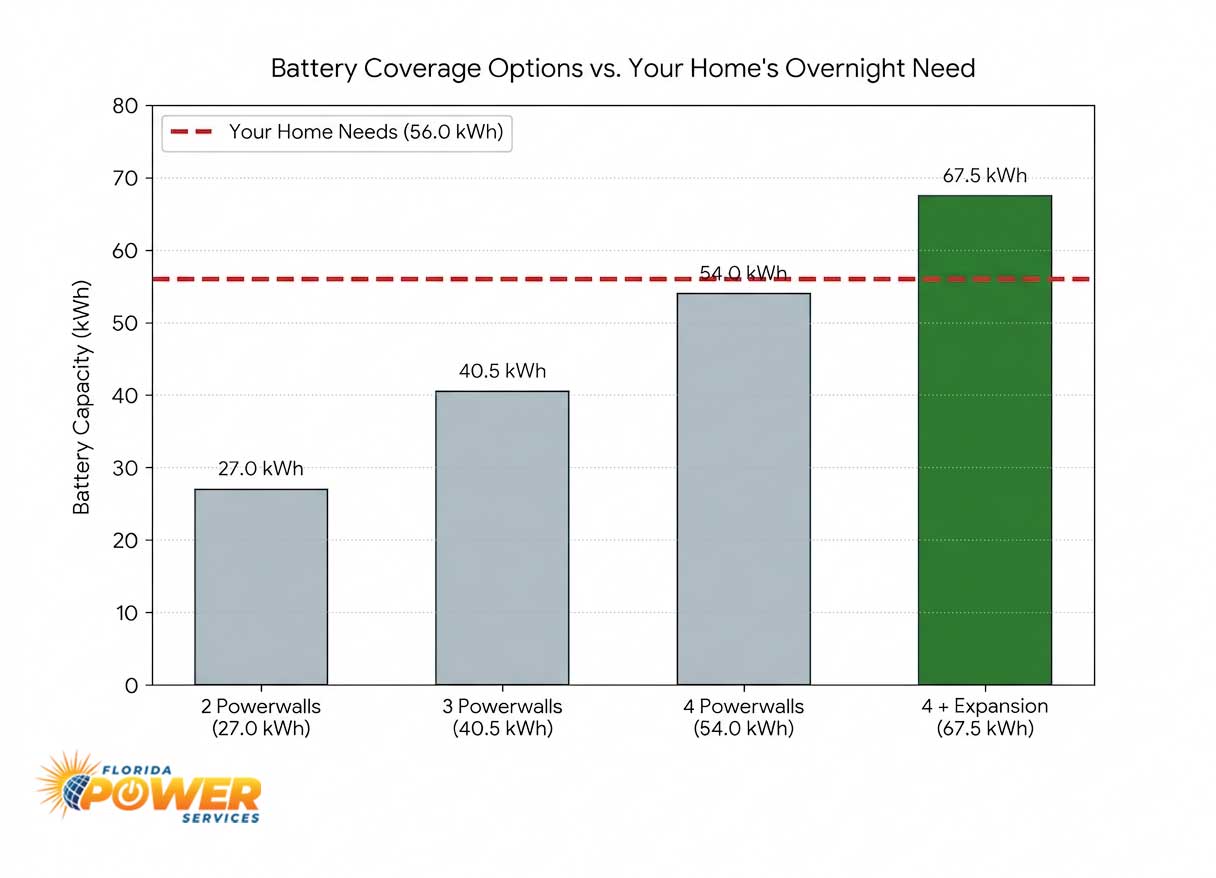
Bottom line: We size your batteries from your actual electricity usage, not a predetermined package.
DO NOT Let Someone Guess at Your Battery Size
Two Powerwalls may be enough for one home and completely inadequate for another.
Calculate How Many Powerwalls I Need
Do Not Forget About Your Electric Vehicle
If the grid is down for a week, you will probably still need to drive.
Your backup plan may need energy for:
- Groceries and supplies
- Medical needs
- Work
- Checking on family
- Storm cleanup
- Emergency travel
For an illustrative EV using approximately 30 kWh per 100 miles:
| Emergency Driving Range | Appx Energy Needed |
| 25 miles | 7.5 kWh |
| 50 miles | 15 kWh |
| 100 miles | 30 kWh |
Return to the home requiring approximately 56 kWh overnight.
Add 50 miles of emergency driving:
56 kWh for the home + 15 kWh for the EV = 71 kWh
| Configuration | Storage | Result |
| 4 Powerwalls | 54 kWh | About 17 kWh short |
| 4 plus 1 Expansion | 67.5 kWh | About 3.5 kWh short |
| 4 plus 2 Expansion | 81 kWh | About 10 kWh of nominal margin |
A system that appears adequate for your house alone may become undersized once your vehicle is included.
Tesla’s Charge on Solar feature can direct available excess solar production to a compatible Tesla vehicle. During an outage, the home and Powerwall reserve may need to be restored before meaningful energy is available for the car.
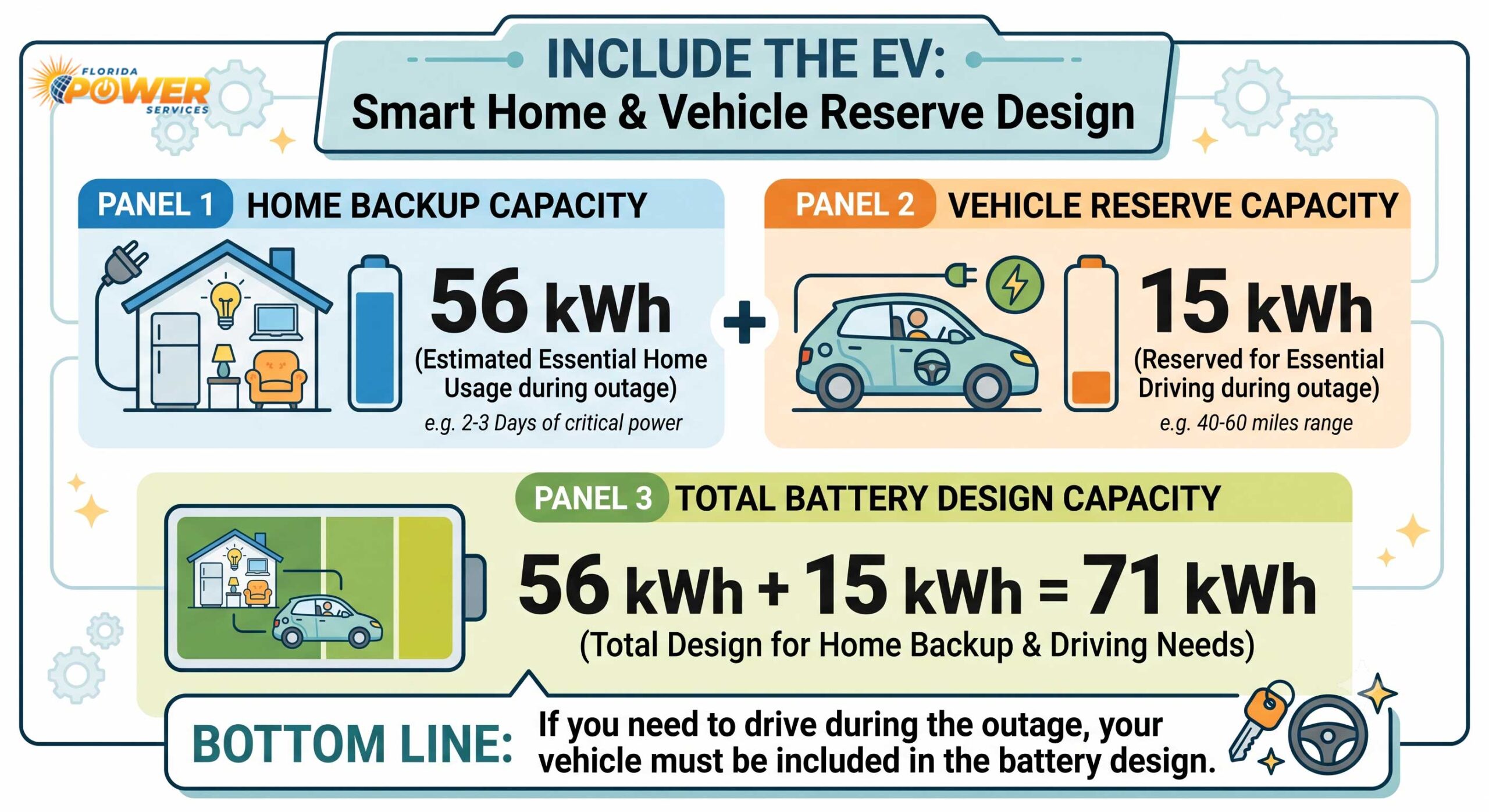
Need Backup for Your Home and Your EV?
Tell us how much emergency driving range you want. We will include it in your Powerwall recommendation.
Include My EV in the Backup Plan
What If Your Home Has 400-Amp Service?
Many larger Florida homes have one 400A meter feeding two main electrical panels.
In the FPS example layout:
- One 400A meter feeds two main panels
- Each panel has its own Tesla Gateway
- Two Powerwalls are shown on each side
- Four Powerwalls provide 54 kWh of storage
- Solar production is divided across the system
The uploaded FPS diagram illustrates this two-panel, two-Gateway configuration.
Tesla Gateway 3 is rated for 200A of continuous current, so a 400A home with two main panels may require separate backup equipment for each side. Final design depends on the property’s existing electrical service.
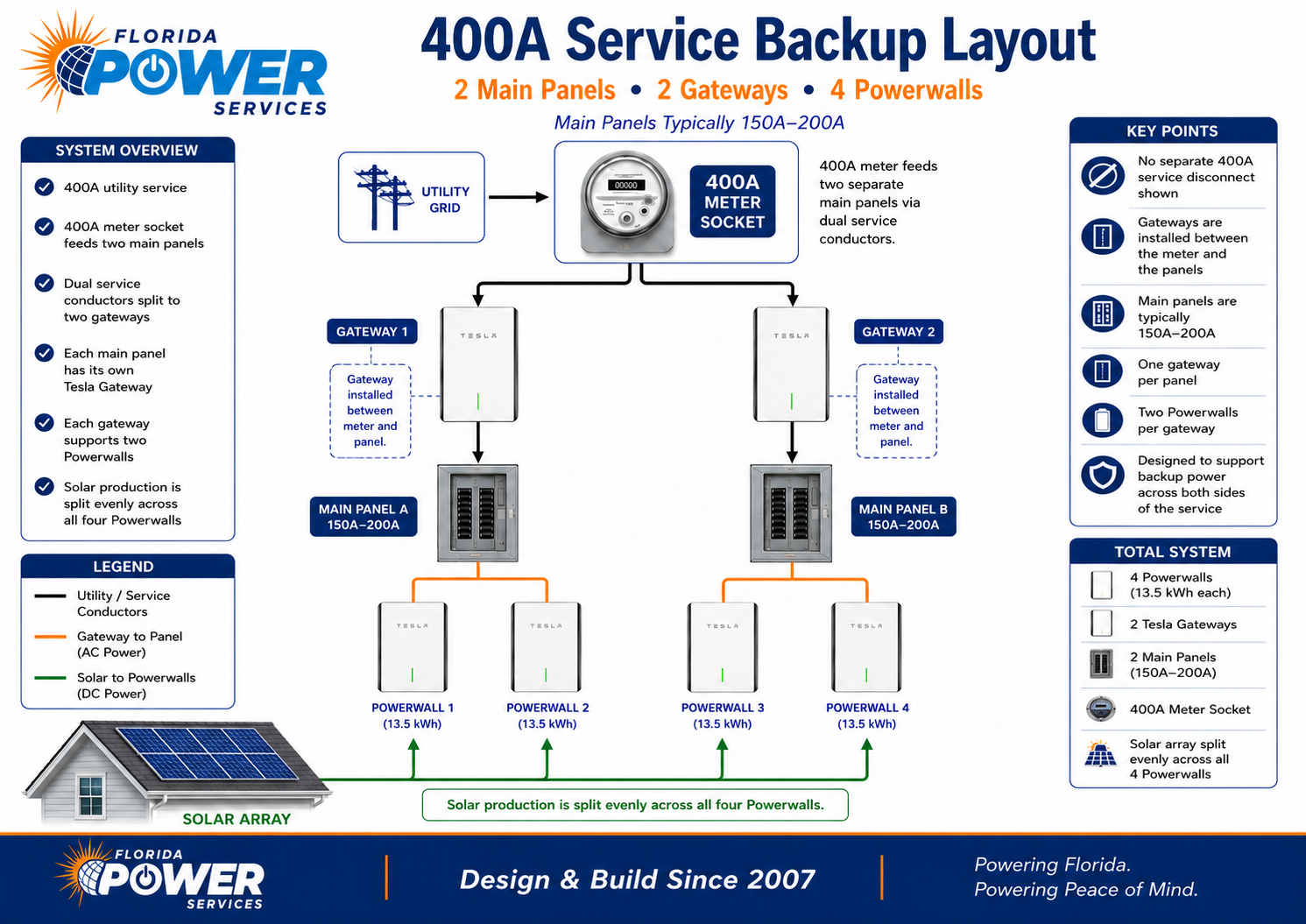
(Example Powerwall design for a 400A Florida home with two main panels, two Gateways and four Powerwalls. Final configuration depends on electricity usage, electrical service and backup goals.)
What Does Whole-Home Backup Really Mean?
Whole-home backup means the battery system is connected to supply your entire home or a major portion of it.
It does not mean:
- Unlimited runtime
- Every appliance running simultaneously
- Continuous full-speed EV charging
- Multiple air conditioners operating without limits
- No need to manage energy during a prolonged outage
Solar can operate household loads and recharge Powerwall during an outage, but production depends on sunlight and weather. Storm Watch can also prepare the batteries for qualifying severe-weather events, but it cannot correct an undersized battery bank.
Your Home Is Not a Standard Battery Package
Before recommending Powerwalls, Florida Power Services evaluates:
- Your electric bill
- Peak-season electricity usage
- Air-conditioning equipment
- Electrical service and main panels
- Overnight household demand
- EV charging reserve
- Desired backup duration
- Available solar production
- Gateway requirements
- Cash and financing options
You will receive a customized recommendation showing the number of Powerwalls, total storage and expected backup coverage.
Do Not Wait Until a Storm Is Approaching
Engineering, permitting, equipment procurement and installation take time.
The best time to prepare for an extended outage is before a hurricane is in the forecast.
Schedule My Powerwall Consultation
Upload a recent electric bill when scheduling for the most accurate recommendation.