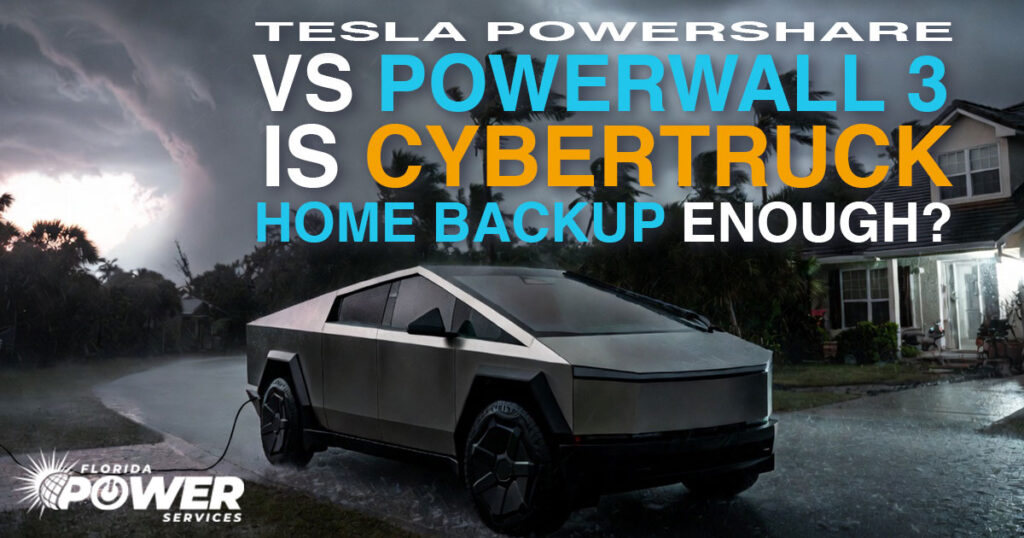
Tesla PowerShare is getting attention because it allows a Cybertruck to provide backup power to your home during a grid outage.
The real question is not whether PowerShare is useful.
It is.
The better question is:
Should you rely on your Cybertruck as your main backup battery, or should you properly size your home with Powerwall 3 first?
For most Florida homes, the stronger answer is clear.
Use solar and properly sized Powerwall 3 storage as the foundation of your backup system. Then add enough extra capacity to support vehicle charging after the storm.
PowerShare can still be valuable, but it should not be used as a shortcut to buy fewer home batteries than your house actually needs.
Quick Answer
Tesla PowerShare Home Backup can provide about 11.5 kW, which is roughly 48 amps at 240 volts.
That sounds strong, but it is not the same as properly backing up your full Florida home.
PowerShare has five major limitations:
- Output: PowerShare is about a 48 amp backup source.
- Panel coverage: PowerShare may only back up selected loads or one backed up section of the home.
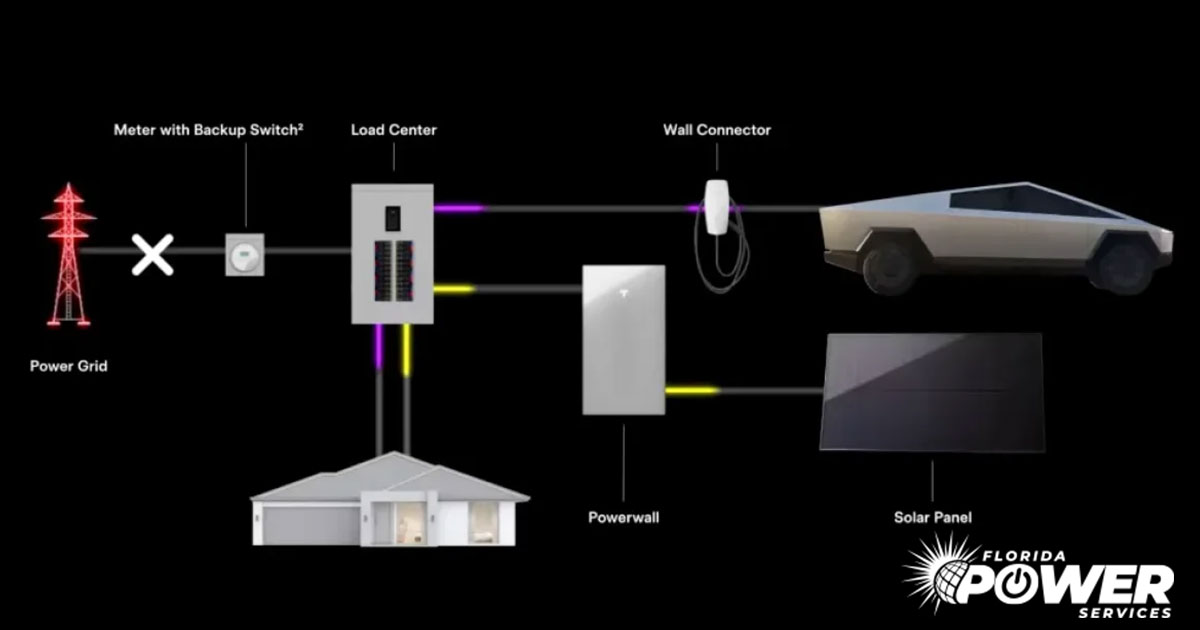
- Infrastructure: PowerShare is not as simple as plugging in your Cybertruck. It requires Tesla backup equipment, a Wall Connector, wiring, permitting, and commissioning.
- Flood exposure: In low lying and coastal areas, your Cybertruck battery is still sitting near driveway or garage level.
- Vehicle range: Every kilowatt hour used to power your home is energy no longer available for driving.
The better Florida backup strategy is simple:
Powerwall 3 carries the home.
Solar recharges the batteries.
Extra system capacity supports vehicle charging.
PowerShare is supplemental reserve, not the foundation.

PowerShare Is Not A Replacement For A Proper Battery Design
The Cybertruck battery is large. Tesla lists the Cybertruck battery at about 123 kWh, which is much larger than a single Powerwall 3.
That is the part people notice.
But battery size alone does not mean your home is properly backed up.
A real backup design is based on:
- How many amps your home may need at one time
- How many kilowatt hours your home uses overnight
- Which panels and circuits are backed up
- How much solar production is available during the day
- How much reserve you want after a storm
- Whether you also want to charge your vehicle
PowerShare can add stored energy, but it does not automatically solve output limits, panel coverage, flood exposure, or post storm driving range.
PowerShare Is Not Just Plugging In Your Cybertruck
Tesla PowerShare Home Backup is not the same thing as plugging your Cybertruck into your house and instantly powering everything.
For home backup, you need either:
- PowerShare Gateway plus Universal Wall Connector
- Powerwall with Wall Connector
That means PowerShare requires a designed electrical system. It may involve:
- Gateway equipment
- Wall Connector installation
- Backed up load design
- Panel work
- Breaker placement
- Metering
- Permitting
- Inspection
- Commissioning
- Utility compliant isolation from the grid

Can PowerShare Charge Your Cybertruck From Solar During An Outage?
Yes, when the system is designed and configured correctly. However, the better design prioritizes solar powering the home and recharging Powerwall 3 first, with PowerShare as reserve.
The Driving Range Tradeoff
This is one of the biggest disadvantages of using your Cybertruck as your primary home backup battery.
When PowerShare sends energy from the Cybertruck to your house, that energy comes out of your vehicle battery.
You may need your vehicle for evacuation, supplies, medical needs, cleanup, and more. Powerwall 3 does not have that tradeoff.
Simple Powerwall Sizing From Your September Bill
Formula:
Monthly kWh ÷ billing days = daily kWh
Daily kWh × 17 ÷ 24 = estimated overnight battery need
Example: 1,800 kWh September bill = 60 kWh per day → ~43 kWh overnight need.
What One To Six Powerwalls Actually Means
Tesla Powerwall 3 stores 13.5 kWh per unit.
| Powerwall 3 Count | Battery Storage | Percent Of 43 kWh Overnight Need | Plain English |
|---|---|---|---|
| 1 Powerwall | 13.5 kWh | 31 percent | Not close |
| 2 Powerwalls | 27.0 kWh | 63 percent | Still short |
| 3 Powerwalls | 40.5 kWh | 94 percent | Close on paper, but no reserve |
| 4 Powerwalls | 54.0 kWh | 126 percent | Better starting point |
| 5 Powerwalls | 67.5 kWh | 157 percent | Strong reserve |
| 6 Powerwalls | 81.0 kWh | 188 percent | Stronger autonomy and vehicle charging support |
Why Vehicle Charging Changes The Battery Math
| Cybertruck Recharge Target | Energy Needed | Powerwall 3 Equivalent |
|---|---|---|
| 20 percent recharge | About 25 kWh | About 2 Powerwalls |
| 30 percent recharge | About 37 kWh | About 3 Powerwalls |
| 50 percent recharge | About 62 kWh | About 5 Powerwalls |
Home overnight (43 kWh) + 30% truck recharge (37 kWh) = ~80 kWh. Six Powerwalls (~81 kWh) make perfect sense.
Why PowerShare Output Is Still Limited
PowerShare Home Backup is about 11.5 kW (48 amps). Powerwall 3 scales output as you add units.
PowerShare May Only Back Up Selected Loads
Many Florida homes have multiple panels. PowerShare only backs up what is wired into the system.
Flood Risk In Low Lying And Coastal Areas
The Cybertruck battery at ground level is more vulnerable than a properly elevated Powerwall 3 installation.
The Right Hierarchy
Solar produces power during the day.
Powerwall 3 carries your home when the grid is down and solar is not producing.
The system includes enough capacity to support vehicle charging after the storm.
PowerShare adds extra reserve when the system supports it.
Final Answer
Tesla PowerShare Home Backup is useful, but it is not automatically enough for most Florida homes. Properly size your home with solar and Powerwall 3 first (typically 4–6 units for a 60 kWh/day home + vehicle charging), then use PowerShare as supplemental reserve.
Need Help Designing A Florida Home Backup System?
Florida Power Services can review your electrical service, panel layout, September electric bill, solar production, Powerwall 3 options, Cybertruck PowerShare compatibility, flood exposure, and vehicle charging needs.
Contact us for a professional load analysis and system design based on real numbers.