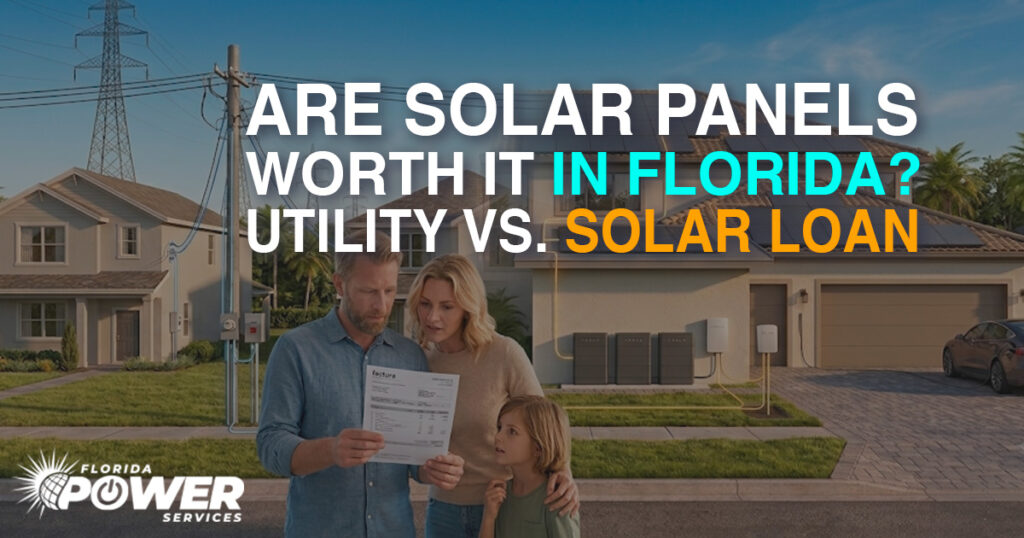
Are Solar Panels Worth It in Florida? Compare Your Utility Bill With Solar Ownership
You already have an energy payment.
It arrives every month as an electric bill.
The question is not whether you will continue paying for electricity. The question is where that money goes and what you receive in return.
With the utility:
- Your payment continues indefinitely
- Your rate can change
- You own nothing after making the payment
- There is no payoff date
With an owned solar system:
- Your scheduled loan payment can remain fixed
- Your payment helps purchase the system producing your electricity
- The loan has a defined ending date
- Eligible loan options can be paid off early without a prepayment penalty
You Are Already Paying for Solar
The difference is whether you continue renting electricity or begin owning the equipment producing it.
See What Solar Would Cost for Your Home
We will use your actual electric bill to calculate the correct system size, estimated payment, energy offset and long-term cost comparison.
Schedule My Solar Consultation
A Real Florida Solar Example
This Florida Power Services proposal was designed for a home using approximately 22,500 kWh per year.
Current Utility Expense vs. Proposed Solar-Ownership Program
| Estimated Monthly Utility Bill | $319 |
| Estimated Monthly Solar Payment | $255 |
| Estimated Annual Utility Expense | $3,825 |
| Estimated Annual Solar Payments | $3,060 |
| Proposed Solar-System Size | 15 kW |
| Estimated Annual Energy Offset | 93% |
The proposal provides the underlying usage, utility-cost, system-size, payment and energy-offset figures.
Immediate Monthly Difference
$319 utility bill − $255 solar payment = $64 per month
The estimated solar payment begins approximately:
20% Below the Current Utility Bill
The first-year payment comparison is:
$3,825 utility expense − $3,060 solar payments = $765
The homeowner is already spending the money.
Solar redirects much of that expense toward an energy system the homeowner owns.
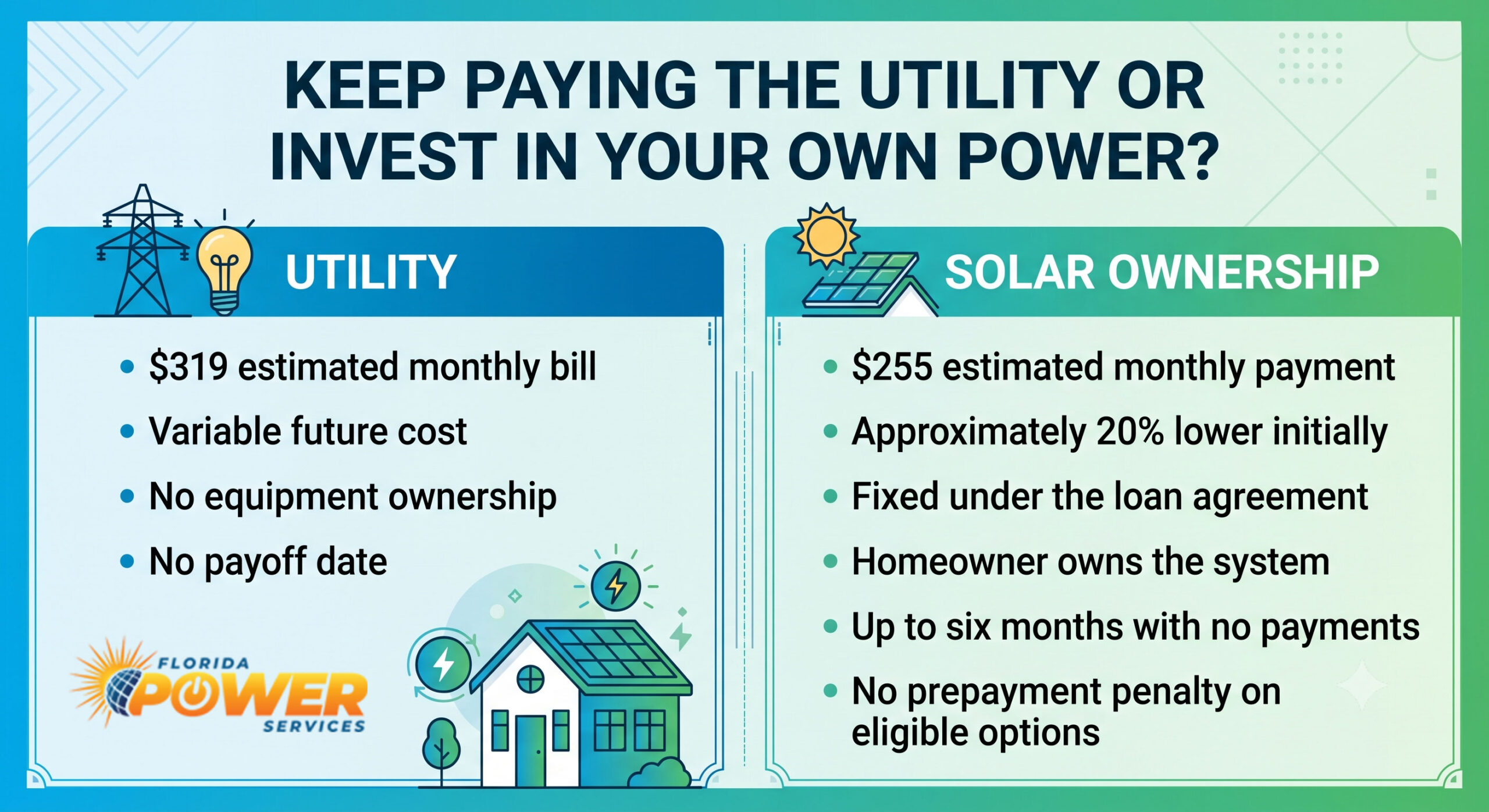
A real Florida Power Services proposal comparing a $319 estimated utility bill with a $255 estimated solar payment for a 15 kW customer-owned system. Actual results vary by property, electricity use, financing and future utility rates.
OWN YOUR POWER. LOCK IN YOUR PAYMENT.
Your Utility Does Not Offer a Fixed Rate
Your utility company does not offer to lock in today’s electricity rate for the next 25 years.
Base rates, fuel charges, storm-recovery costs and other approved charges can change throughout the time you own the home.
One major Florida example shows how substantial those changes can become. A typical FPL residential bill increased from approximately $101.70 in 2021 to $136.64 in 2026. That represents approximately a 34% cumulative increase over five years.
That does not mean every Florida utility will increase its rates by the same amount.
It does mean that assuming your electric bill will never increase may be the least realistic long-term scenario.
Florida Power Services presents several possible rate scenarios so you can evaluate the decision without depending on one aggressive projection.
What Could the Utility Cost Over 25 Years?
Starting with the example’s current annual utility expense of $3,825:
Assumed Annual Utility Increase vs. Modeled 25-year Utility Cost
| 0% | $95,625 |
| 2% | $122,516 |
| 4% | $159,296 |
| 6% | $209,857 |
| Fixed Solar Payments | $76,500 |
The proposal’s 25-year model shows approximately $209,858 in utility spending compared with $76,500 in solar-program payments under its 6% annual utility-escalation scenario.
How Much Lower Are the Modeled Solar Payments?
| Utility-Rate Scenario | Solar Payments Are Lower By |
| No utility increase | 20% |
| 2% annual increase | 37.6% |
| 4% annual increase | 52% |
| 6% annual increase | 63.5% |
These are planning scenarios, not guaranteed savings.
Remaining utility charges, uncovered electricity use, changes in consumption, system production and financing terms still apply.
The key result is straightforward:
Even if the utility never raises its rates, the modeled solar payments are approximately 20% lower.
At a 4% annual utility increase, the modeled solar payment total is approximately 52% lower than continuing to purchase all electricity from the utility.
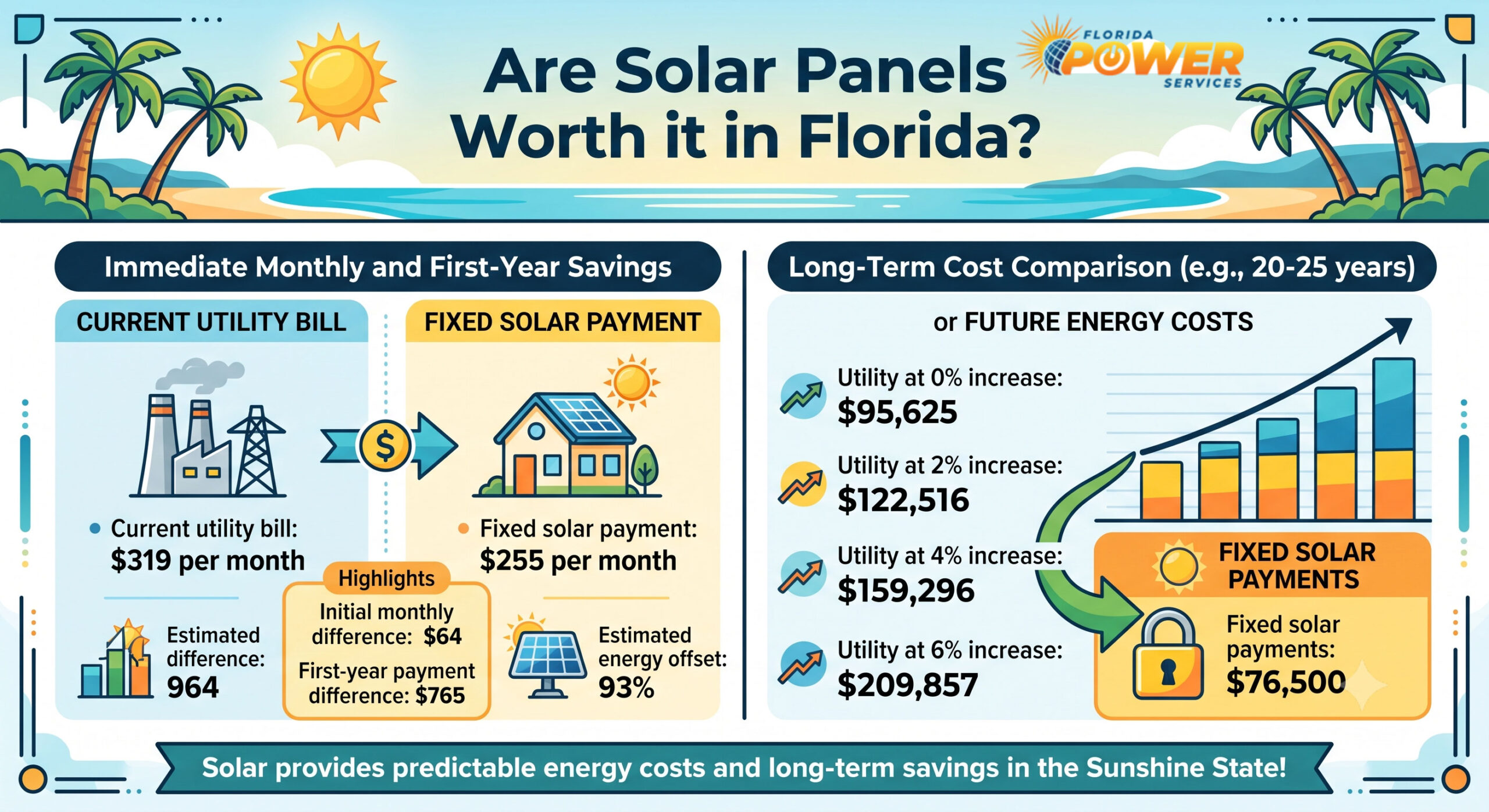
Your electric bill only shows what you owe this month. A complete solar analysis shows what your utility and solar payments could total over the next 25 years.
EVEN WITH NO UTILITY INCREASE, SOLAR IS MODELED 20% LOWER.
See Your 25-Year Comparison
Compare My Utility and Solar Costs
Why We Recommend Solar Ownership Instead of a Lease
Florida Power Services does not offer solar leases.
We recommend customer ownership through a fixed-payment solar loan.
A solar lease may advertise a low starting payment, but the solar company generally owns the equipment.
Depending on the contract, the lease may also contain an annual escalator. An escalator is a contract provision that increases the scheduled payment over time.
That means the payment shown in the advertisement may not be the payment you make five, ten or twenty years later.
A Low Starting Payment Is Not the Same as a Low Total Cost
Consider an illustrative lease beginning at the same $255 monthly payment as the Florida Power Services loan example but increasing by 3% annually:
| Contract Year | Monthly Lease Payment |
| Year 1 | $255 |
| Year 5 | $287 |
| Year 10 | $333 |
| Year 15 | $386 |
| Year 20 | $447 |
| Year 25 | $518 |
Over 25 years:
- Fixed $255 payment stream: approximately $76,500
- Illustrative lease with a 3% annual escalator: approximately $111,565
- Additional cost from the illustrative escalator: approximately $35,065
The escalating lease would cost approximately 46% more than the fixed payment stream in this illustration.
Not every lease has the same terms.
Before signing a lease, review:
- Annual escalator
- Contract length
- Equipment ownership
- Home-sale transfer requirements
- Early termination provisions
- Buyout options
- End-of-contract terms
Do Not Replace One Escalating Energy Payment With Another
The objective of going solar should be to gain more control over your energy costs.
Utility vs. Solar Lease vs. Solar Ownership Loan
| Option | Who Owns the System? | Payment Structure | Payoff Date |
| Utility | No system ownership | Variable | None |
| Solar Lease | Third Party | May include an annual escalator | Contract dependent |
| FPS Solar Loan | Homeowner | Fixed under the loan agreement | Defined loan term |
Utility
You continue purchasing electricity at rates controlled by the utility.
The payment continues for as long as you need electricity.
Solar Lease
A third party owns the equipment.
The payment may start low but can increase annually when the contract contains an escalator.
Solar Ownership Loan
You own the equipment.
The payment remains fixed under the loan agreement, the loan has a defined ending date and eligible options may be paid off early without a prepayment penalty.
Ownership Is the Difference
A utility payment buys one month of electricity.
A lease payment rents someone else’s equipment.
A solar-loan payment helps you own the system producing your power.
The Florida Power Services Solar Loan Program
Current solar-financing options may include:
- Fixed monthly payments
- Terms from 10 to 30 years
- Up to six months with no payments
- No prepayment penalty on eligible options
- No-dealer-fee options
- Homeowner system ownership
Financing is subject to credit approval and current lender terms.
For most properly sized grid-tied systems proposed by Florida Power Services, the estimated solar payment begins below the homeowner’s current average utility bill.
In this example:
- Current estimated utility bill: $319
- Estimated solar payment: $255
- Initial monthly difference: $64
- Initial percentage difference: approximately 20%
The utility rate can change.
The scheduled solar-loan payment remains fixed under the loan agreement.
Compare My Solar-Ownership Options
What Do Six Months With No Payments Mean?
Qualified borrowers may receive up to six months with no solar-loan payments.
At the example’s $255 payment:
$255 × 6 months = $1,530 in deferred payments
This can provide early cash-flow flexibility while the installation is completed, the system receives Permission to Operate and solar production begins.
It does not mean the property automatically receives six months of free electricity.
The homeowner may still have utility charges, and actual early savings depend on:
- Installation timing
- Utility approval
- Solar production
- Household consumption
- Remaining utility charges
- Final lender terms
What Does 93% Solar Offset Mean?
A 93% energy offset means the system is estimated to produce electricity equal to approximately 93% of the home’s annual energy consumption.
It does not mean the complete utility bill will fall by exactly 93%.
The system owner may still pay:
- Monthly utility connection charges
- Electricity not covered by solar
- Taxes or franchise fees
- Minimum billing requirements
- Seasonal differences between usage and production
A credible solar proposal should show the estimated energy offset and explain what utility charges may remain.
Are Solar Panels Worth It in Florida?
They can be when:
- The system is properly sized
- The roof has adequate usable space
- Shading is limited
- Production estimates are realistic
- The financing terms are clearly disclosed
- The solar payment compares favorably with the current utility expense
- The homeowner owns the system
Solar is not automatically the correct decision for every property.
But continuing with the utility is not a free alternative.
You are already paying every month, at rates you do not control, with no ending date.
The Real Decision Is Not Whether You Will Pay for Electricity
It Is Whether Those Payments Continue Going Entirely to the Utility or Begin Building Solar Ownership
Why Florida Power Services?
Solar is both a financial and construction decision.
The company preparing the financial comparison should also understand the engineering, permitting, installation and long-term performance of the system.
Florida Power Services was established in 2007 and is backed by more than 23 years of specialized Florida solar experience. We manage design, engineering, permitting, installation, utility interconnection and final commissioning through one design-build company.
Our credentials include:
- Florida State-Certified Solar Contractor
- NABCEP Certified PV Installer
- FSEC certification
- Experienced Florida installation team
- Long-term system service and support
The example proposal identifies Florida Power Services as the installer and documents its state, NABCEP and FSEC credentials.
You work directly with the contractor responsible for designing and delivering the system, not a sales organization handing the project to an unknown installer.
Frequently Asked Questions
Can a solar payment be lower than my electric bill?
Yes. In this example, the estimated $255 solar payment begins approximately 20% below the current $319 utility bill. Actual results depend on electricity use, financing, system size and property conditions.
Does the solar-loan payment increase each year?
The Florida Power Services financing options discussed here use a fixed scheduled payment under the loan agreement. The final lender disclosure controls the payment, APR, term and total cost.
Do solar leases increase every year?
Some leases contain annual escalators, while others may use fixed payments. Review the actual contract rather than relying on the starting payment shown in an advertisement.
Who owns the system with a solar loan?
The homeowner owns the solar system. A lease generally leaves ownership with the leasing company.
Can I pay the solar loan off early?
Eligible Florida Power Services financing options may be paid off early without a prepayment penalty. Confirm the terms in the final loan agreement.
Does solar eliminate the entire electric bill?
Usually not. Utility connection charges, uncovered usage, taxes, minimum bills and other charges may remain.
How do I find out whether solar makes sense for my home?
Start with a recent electric bill. Florida Power Services will calculate your annual usage, recommended system size, expected production, estimated payment and long-term comparison.
See What Solar Would Look Like for Your Home
Florida Power Services will calculate:
- Your annual electricity consumption
- Current monthly and annual utility cost
- Recommended solar-system size
- Estimated annual production
- Estimated energy offset
- Fixed-payment financing options
- Initial monthly difference
- Remaining utility charges
- Multiple 25-year utility scenarios
- Ownership-versus-lease comparison
No lease.
No annual solar-payment escalator.
No third-party system ownership.
No generic estimate or predetermined system package.
Your Electric Bill Only Shows This Month
We Will Show You the Next 25 Years.
Schedule My Solar Consultation
Upload a recent electric bill for the most accurate system design and financial comparison.
All utility-cost, production, payment and savings figures are estimates. Actual results vary based on usage, utility rates, fees, weather, system production, financing terms and property conditions.