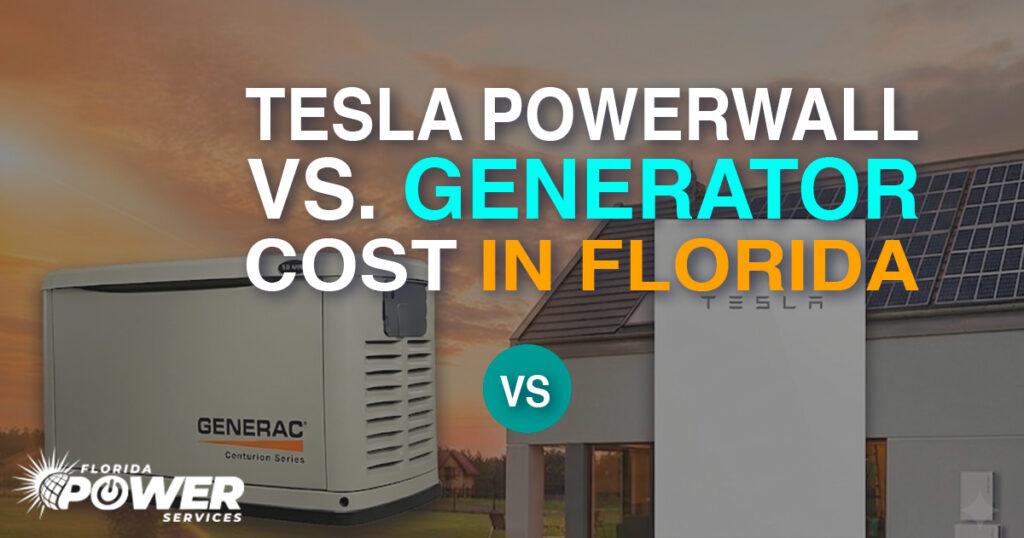
Tesla Powerwall vs. Generator: Which Is the Smarter Backup System for Your Florida Home?
A whole-house generator often appears less expensive because you are shown the price of the generator itself.You are not always shown the complete cost of making it operational.
By the time you add the transfer equipment, electrical work, propane tank or natural-gas piping, two permits, site work and initial fuel, a substantial Florida generator installation can easily reach $25,000 to $30,000.
If your home has 400-amp service, two main panels or flood-zone installation requirements, the cost can climb significantly higher.
The correct comparison is not:
Generator equipment versus installed Powerwall
It is:
A fully installed and fueled generator versus a properly sized solar and Powerwall system
What Would Each Option Require at Your Home?
We will review your electricity usage, electrical service, air conditioning, EV charging and property conditions before recommending a backup system.
Get My Custom Backup Comparison
What Does a Whole-House Generator Really Cost in Florida?
The generator is only the beginning.
A complete propane-generator installation may include:
- Standby generator
- Automatic transfer switch
- Electrical conductors and service modifications
- Propane-storage tank
- Tank installation and initial fuel
- Gas piping and regulators
- Trenching and site work
- Concrete pad or structural mounting
- Electrical permit
- Gas or mechanical permit
- Engineering, inspections and startup
An $8,000 generator is not an $8,000 backup-power system.
Once the entire project is permitted, installed and fueled, the cost may be much closer to a properly sized Powerwall system than the original equipment price suggests.
Flood-zone properties can widen the gap further. If the generator must be elevated, the project may require an engineered platform, structural and wind-load engineering, longer electrical and fuel runs, building reinforcement and crane or rigging costs.
Powerwall 3 can be wall- or floor-mounted, which generally makes elevated placement easier than installing a large generator and its associated fuel infrastructure.
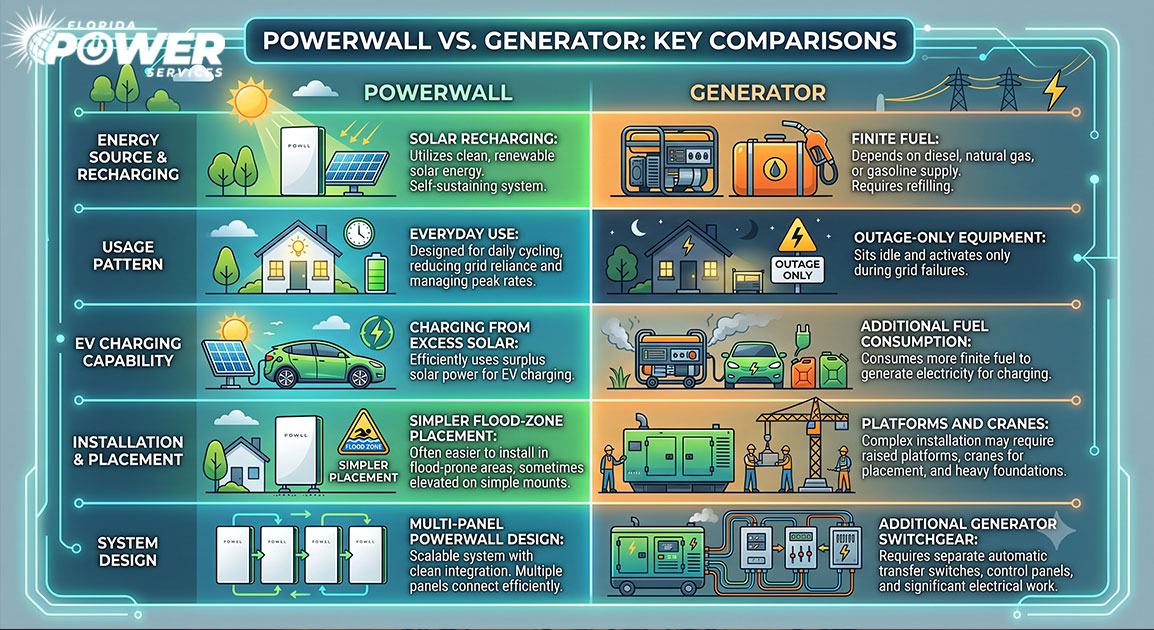
A properly sized solar and Powerwall system produces new energy each day. A generator continues operating only while fuel remains available.
Compare the Complete Systems, Not Just the Equipment
See What Backup Would Cost for My Home
A 400-Amp Service Can Change the Entire Generator Project
Many larger Florida homes have one 400-amp meter feeding two separate 150- or 200-amp main panels.
A standard generator package commonly includes one 200-amp transfer switch. Backing up both sides of a 400-amp service may require:
- Two automatic transfer switches
- A 400-amp service-rated transfer solution
- Additional switchgear
- Work on both main panels
- Larger conductors and raceways
- More extensive service reconstruction
- Load-management equipment
- A larger generator
- Additional engineering and permits
On a complex property, the complete generator installation can approach twice the cost of a straightforward 200-amp project.
A Powerwall system must also be properly designed for both panels. Tesla Gateway 3 has a 200-amp continuous-current rating, so a two-panel 400-amp home may require one Gateway for each side of the service.
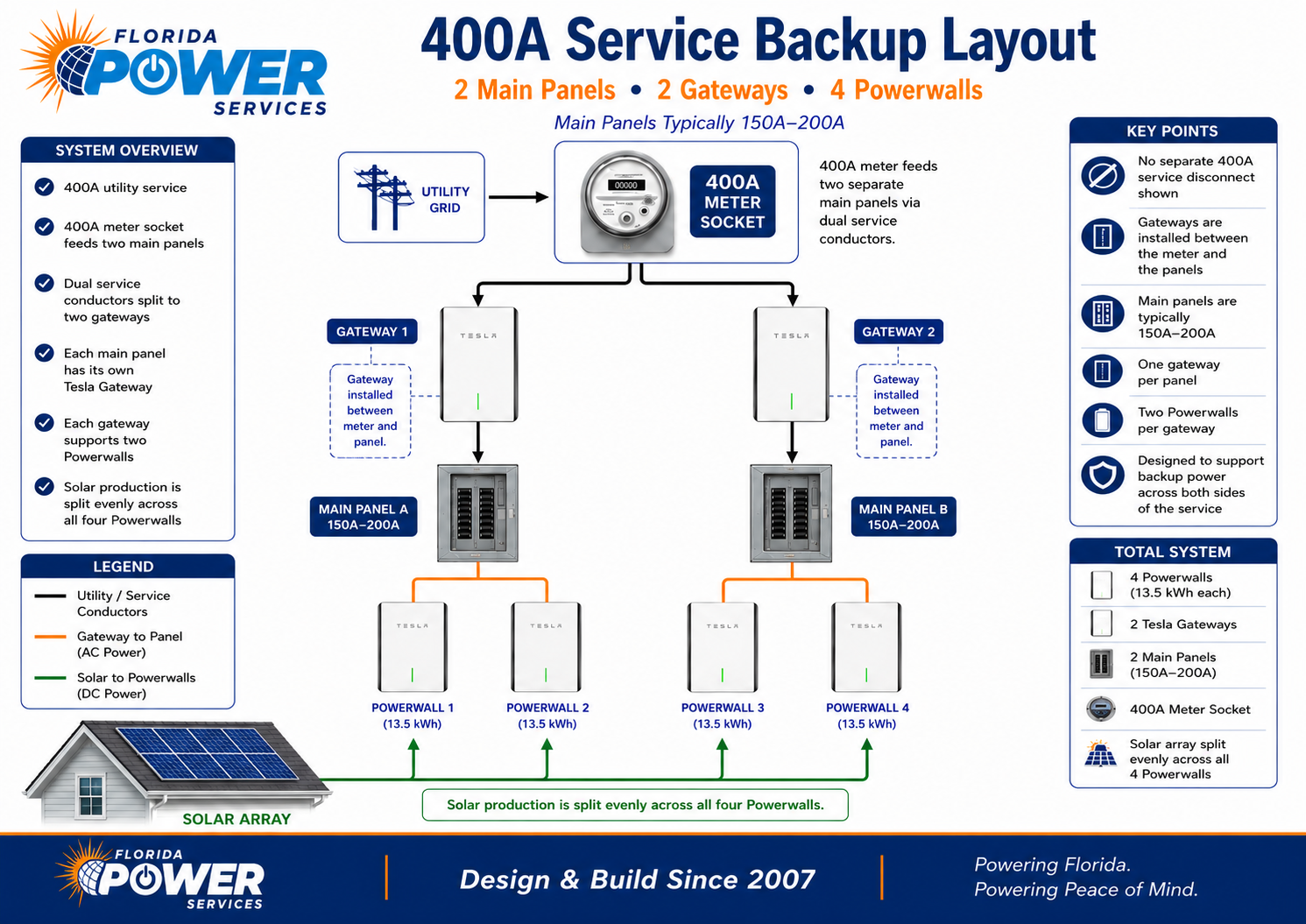
Example Powerwall 3 backup architecture for a 400-amp Florida home with two main panels, two Tesla Gateways and four Powerwalls. Final equipment and battery quantity depend on the home’s usage, service configuration and backup requirements.
Have a 400-Amp Home?
Do not accept a generator or battery quote that ignores your second main panel.
Review My 400-Amp Backup Design
Propane Backup Lasts Only as Long as the Fuel Supply
A propane generator operates until the tank is empty.
The actual runtime depends on:
- Tank capacity
- How full the tank was before the storm
- Generator size
- Household demand
- Air-conditioning use
- EV charging
- Fuel conservation
- Road access
- Propane availability
- Whether a delivery truck can reach your property
A larger tank provides more runtime, but it also increases the cost, space requirements and installation complexity.
After a major hurricane, the timing of your next propane delivery is outside your control. You may be competing with many other customers while roads and local infrastructure are still recovering.
The generator replaces dependence on the electrical grid with dependence on stored fuel and the next delivery truck.
Properly Sized Solar and Powerwall Can Repeat the Cycle Every Day
A properly sized solar and Powerwall system operates differently.
During the Day
Solar powers your home’s active loads.
Available production then recharges the Powerwalls for the coming night.
Additional solar can charge your EV after the home and battery reserve are protected.
During the Night
The Powerwalls carry your home after solar production ends.
The battery bank is sized around your overnight consumption, air-conditioning demand, storm reserve and transportation needs.
The Following Morning
Solar production begins again.
The system resumes powering the home and recharging the batteries.
Then the cycle repeats:
Solar powers the home by day, charges the batteries, and the batteries carry the home through the night.
Each full Powerwall 3 provides 13.5 kWh of nominal storage, up to 11.5 kW of continuous AC output and support for up to 20 kW of DC solar input. Tesla supports as many as four full Powerwall 3 units and three Expansion batteries in its maximum listed configuration.
The important words are properly sized.
The solar array must be large enough to:
- Power daytime household loads
- Replace the energy used overnight
- Recharge the batteries before evening
- Account for reduced storm production
- Support EV charging when needed
The batteries must be large enough to:
- Carry the home through the night
- Operate the expected air-conditioning loads
- Maintain storm reserve
- Cover cloudy conditions
- Preserve emergency driving range
A generic one- or two-battery package may not accomplish that.
Your EV Must Be Included in Both Designs
If the power is out for a week, you will still need transportation.
Charging an EV affects both systems.
With a generator
The EV charger adds another major load. It may require a larger generator, load management or reduced charging amperage.
Every kilowatt-hour sent to the vehicle consumes more propane and shortens the tank’s remaining runtime.
You may eventually have to choose between preserving fuel for the house and charging the car.
With solar and Powerwall
The EV also increases the required solar production and battery reserve, but the additional energy can be produced onsite.
During an extended outage, the design priority is:
- Power the home during the day.
- Recharge the Powerwalls for the coming night.
- Use additional solar production to charge the vehicle.
Tesla’s Charge on Solar feature can continue charging a compatible Tesla vehicle from excess solar while the home is off-grid, unless Powerwall needs to preserve energy for household backup.
The vehicle must be included when calculating both:
- The amount of electricity required
- The rate at which the vehicle can be charged without competing with the home
A Generator Burns Through Fuel. Solar Produces New Energy
This is the fundamental difference.
A generator continuously moves toward an empty fuel tank.
A properly sized solar and Powerwall system can produce new energy when the sun returns, restore the batteries and repeat the process the following day.
Powerwall can also use Tesla Storm Watch to respond to qualifying severe-weather alerts and charge to maximum capacity before a possible outage.
That does not mean a battery system can be undersized.
The solar production, battery storage, air-conditioning loads, electrical service and EV charging must be engineered as one complete system.
For a Florida home where solar is practical, Florida Power Services recommends properly sized solar and Powerwall over a fuel-dependent standby generator.
Experience Matters When Your Backup System Has to Work
Backup-power design is not a standard equipment package.
Your contractor must understand:
- Solar production
- Battery-storage sizing
- Air-conditioning loads
- EV charging
- 200- and 400-amp electrical services
- Multiple main panels
- Flood-zone construction
- Florida wind engineering
- Permitting
- Utility requirements
- Multi-day outage planning
Florida Power Services has specialized in photovoltaic solar and battery storage since 2007 and brings more than 23 years of hands-on solar experience. Joe Forest is a Florida State-Certified Solar Contractor, NABCEP Certified PV Installer and FSEC Certified PV Installer. Florida Power Services handles design, engineering, permitting, installation, interconnection and commissioning through one experienced design-build company.
You are working directly with the contractor responsible for making the system perform, not a sales company handing the project to an unknown third party.
Find Out What Proper Backup Would Require for Your Home
During your consultation, we will review:
- Your electric bill
- Air-conditioning equipment
- EV and emergency-driving requirements
- 200- or 400-amp electrical service
- Number of main panels
- Flood-zone conditions
- Generator placement
- Propane or natural-gas requirements
- Powerwall quantity
- Solar-recharging capacity
- Desired backup duration
- Complete installed cost
The consultation takes approximately 15 to 20 minutes. Uploading a recent electric bill allows us to prepare a more accurate recommendation. Florida Power Services uses a no-pressure approach and states that it does not sell or share consultation information.
Do Not Wait Until a Hurricane Is in the Forecast
Engineering, permitting, equipment procurement and installation take time.
Schedule My Backup Power Consultation
Get a backup system designed around your home, your vehicle and the way you expect to live when the grid is down.