If history shows us one thing, it’s this: utility power never becomes more homeowner‑friendly over time. Rates change, surcharges are added, and the homeowner has no control over any of it. That’s why the discussion around solar lease vs solar loan vs cash is so important. Choosing how you pay for solar will shape your long‑term savings, your monthly cash flow, and the level of control you have over rising utility costs.
To illustrate the stakes, let’s use a simple example. Assume an 11.4‑kW solar system offsets around $238 per month at today’s rates, producing roughly $2,856 in first‑year savings. If utility power rises by 6.1 % per year, a conservative assumption in Florida, the value of those savings grows every year. This compounding effect is the foundation of the comparison you’re about to read.
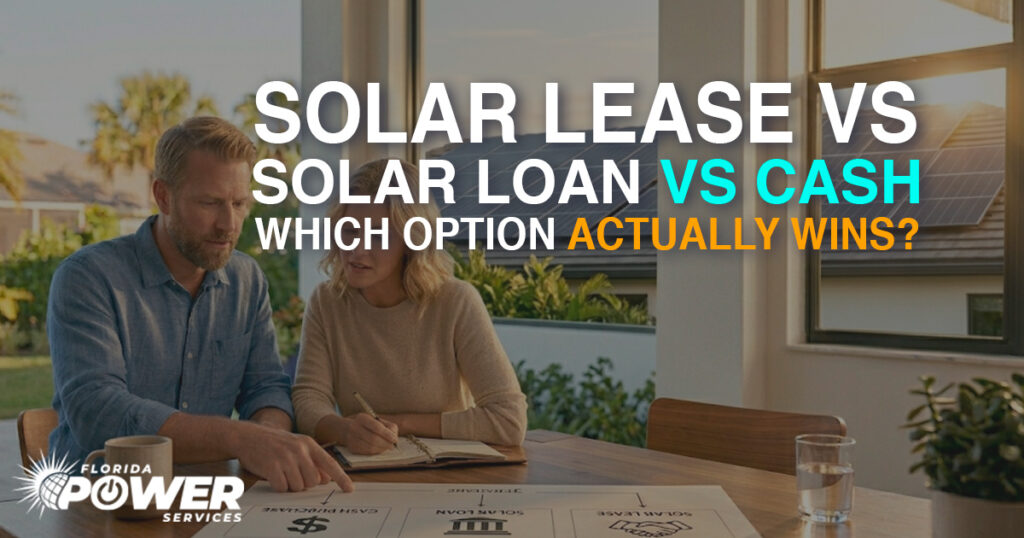
Why The Solar Lease vs Solar Loan vs Cash Comparison Matters
Most homeowners start by looking at the monthly payment. That makes sense; no one wants to stretch their budget too thin. But focusing only on the first monthly number misses the bigger picture.
A lease can look easier because the starting payment is lower. A loan can look heavier because it’s tied to ownership. Cash can feel like the biggest move up front. Once you follow the math forward, however, the picture becomes much clearer: cash is king, loan is next best, and lease comes last.
Florida Power Services has helped many families navigate the solar lease vs solar loan vs cash decision. If you’re still early in your solar journey, check out our complete checklist for installing solar panels to understand the steps involved.
Cash Is King
A cash purchase is the strongest financial outcome because it removes financing costs altogether and lets the homeowner keep the full value of the solar savings. Using our 11.4‑kW system example, the system starts by saving about $238 per month, $2,856 in year one. With utility costs rising at 6.1 % per year, cumulative savings grow to about $19,972 by year six, $24,046 by year seven, $28,369 by year eight, and $32,955 by year nine. That puts the payback period at roughly eight years.
By year 25, total avoided utility cost grows to about $158,918. That’s why cash is king: once the system is paid for, the homeowner keeps the savings instead of sending money to a lender, a leasing company, or the utility.
If you’re worried about your roof’s condition, it may be a good time to consider upgrading your roof at the same time. Our blog on replacing your roof and installing solar panels outlines how combining the two projects can save money and coordination headaches. We also explain how to choose the best roof types for solar panels in Florida so you can be confident your investment is protected for decades.
What about Tax Incentives?
Remember that federal and state incentives apply only when you own the system. The U.S. Department of Energy’s homeowner guide explains that to claim the federal residential solar energy credit, you must own the system, purchased outright or financed. Leasing does not qualify for the credit.
DSIRE, the Database of State Incentives for Renewables & Efficiency, is the most comprehensive source for incentives and policy information for renewables. It’s worth checking DSIRE for Florida‑specific incentives when comparing your options.
Lease: Easier Up Front but Weaker Long‑Term
Leases promise a low entry point, around $145/month, but they come with an annual escalator (e.g., 2.9 %) that pushes payments to about $188 by year 10 and $288 by year 25, totaling roughly $62 k in payments over 25 years.
In the solar lease vs solar loan vs cash debate, this option offers minimal risk and includes maintenance, but you never own the panels, miss out on federal tax credits and local incentives, and lease payments typically rise each year.
Because the equipment remains third‑party property, it doesn’t add to home value and may even be seen as a liability when selling. If your roof needs replacing, the panels must be removed and reinstalled by the lease provider. Learn more about the process through our guide on solar panel removal and reinstall for roof replacement. These realities explain why leases usually rank last in the solar lease vs solar loan vs cash comparison.
Loan: Better Than Lease (If You Use It the Right Way)
Loans bridge the gap between cash and leasing in the solar lease vs solar loan vs cash conversation. By financing with a fixed‑rate solar loan, you own the system from day one and can still claim tax credits and net‑metering benefits.
In our example, accelerating payments to roughly a 10‑year payoff yields a monthly bill of about $354, with total outlay near $43,548, but when lease payments are still climbing, your loan could already be paid off. This middle‑ground approach provides predictable payments, eligibility for incentives, and an increase in property value.
Make sure your roof and electrical service are ready (use our solar‑ready roof design guide), then use the financing period strategically. Used wisely, loans rank second only to cash in the solar lease vs solar loan vs cash hierarchy.
Solar Lease vs Solar Loan vs Cash: What Actually Wins?
- Lowest starting payment: Lease usually wins. Expect escalating payments over the life of the agreement.
- Ownership with payment flexibility: The loan is stronger. Use the long term for flexibility, then accelerate payments to reach ownership quickly.
- Best long‑term financial outcome: In the solar lease vs solar loan vs cash comparison, cash is the clear winner. Payback in ~8 years and over $158,000 in avoided utility costs over 25 years make this option unbeatable.
In other words:
- Cash purchase is the best long‑term financial move.
- A loan is the next best option because it leads to ownership and allows you to capture tax incentives.
- A lease is the weakest long‑term position because you keep paying without owning the asset and miss out on tax credits and potential home value increases.
Why Rising Utility Costs Change Everything
Electricity in Florida costs about $0.16 per kWh, roughly 19 % lower than the national average, and prices continue to climb. Doing nothing leaves you exposed to rate hikes; every year you stay dependent on utility power is another year of uncertainty. In the solar lease vs solar loan vs cash comparison, ownership, whether purchased outright or financed, locks in your energy costs and lets you benefit as utility rates rise.
Request Your Solar Quote
Request a personalized quote from Florida Power Services and see what the numbers look like for your home.
Interested in exploring your options side by side?
We’ll help you understand the real numbers, compare the solar lease vs solar loan vs cash paths, and choose the option that puts you in the strongest long‑term position.
Common Questions Homeowners Ask
Is a solar lease cheaper than a solar loan?
A lease often starts lower, but annual escalators raise costs while you miss out on tax credits and incentives. A loan’s initial payment is higher, yet it builds equity and qualifies you for incentives, making the solar lease vs solar loan vs cash comparison crucial for long‑term savings.
Why is cash the best option for solar?
Paying cash eliminates financing charges, lets you keep the full value of the savings, and delivers the fastest payback. Once the system is paid off, all future utility savings stay with you.
Can a solar loan beat a lease?
Yes. Using a loan as a path to ownership (and not stretching it to 30 years) means you can pay off the system while lease customers are still facing escalations. Loans also allow you to claim incentives not available with leases, further tilting the solar lease vs solar loan vs cash comparison toward ownership.
What happens if I sell my home with a leased system?
Leases may complicate resale because the new homeowner must assume or buy out the lease. Owned systems are generally seen as assets that enhance property value.
Can I pay off a solar lease early?
Some leases offer buyout options, but terms vary widely. Always read the contract carefully before committing.
Why does utility inflation matter so much?
As electricity rates climb, the savings from owning your system grow. That’s why the solar lease vs solar loan vs cash debate ultimately comes down to locking in your costs and capturing the greatest long‑term value.